
History · Montefiesole · Pontassieve
Tassinaia did not start out as a farm stay: it is a hamlet more than seven centuries old. Local history books, old maps and the memories of the people who lived here tell its story.
A thirteenth-century villa
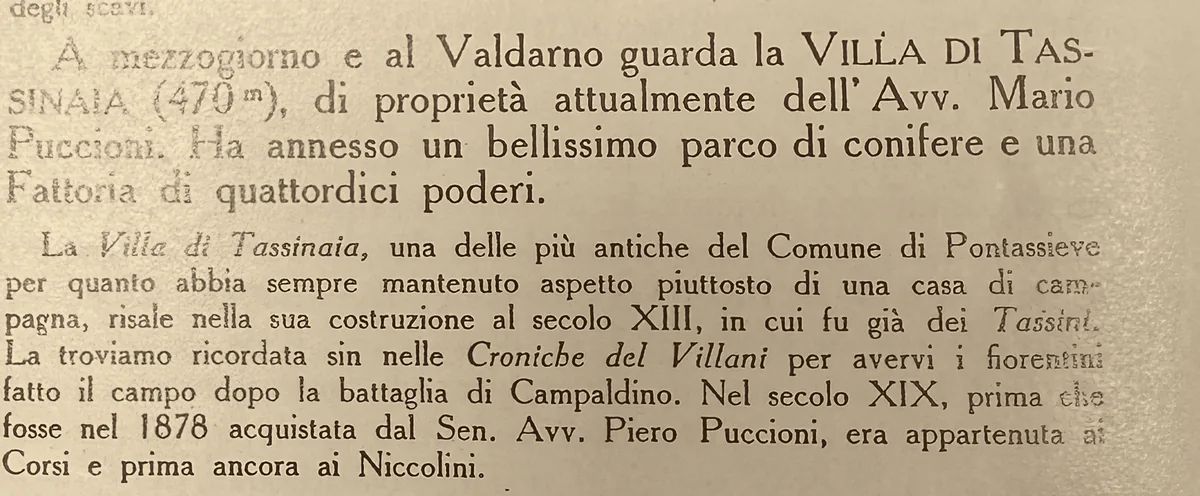
A historical guide to the area describes the Villa di Tassinaia, at 470 metres, facing “south and the Valdarno”. It calls it “one of the oldest in the Comune of Pontassieve”: although it has always kept the look of a country house, it was built in the 13th century, when it belonged to the Tassini family.
After Campaldino: the Florentine camp
On 11 June 1289 the Florentine Guelphs defeated the Ghibellines of Arezzo at the battle of Campaldino. Among Florence’s mounted feditori was the young Dante Alighieri.
According to the same guide, the Villa di Tassinaia is already mentioned in Villani’s Chronicles, because the Florentines made camp there after the battle of Campaldino.
“In quei di Tassinara”: according to an oral tradition of the Passigli family, Dante stopped here to rest on his way back to Florence after Campaldino.
It is worth being clear: the chronicle records the Florentine army’s camp, while Dante’s stop is a family memory, which we collected by interviewing Mrs Passigli, not a documented fact. We also tell this story in our article on the hamlet of Montefiesole, Dante and Shelley.
The families of Tassinaia
The hamlet changed hands several times over the centuries. This is the sequence as the sources reconstruct it:
- 13th centuryThe villa belongs to the Tassini.
- 1289The Florentines camp here after Campaldino (Villani’s Chronicles, as cited by the guide).
- Before the 19th centuryOwned by the Niccolini.
- 19th centuryBelongs to the Corsi.
- 1878Bought by Senator and lawyer Piero Puccioni. The guide later lists it as owned by lawyer Mario Puccioni, with a conifer park and a fattoria of fourteen poderi (farms).
- Early 20th centuryThe hamlet passes to the Passigli family.
- 1970sThe Tenuta di Tassinaia is still run by the Passigli family.
Tassinaia among the farms of San Lorenzo
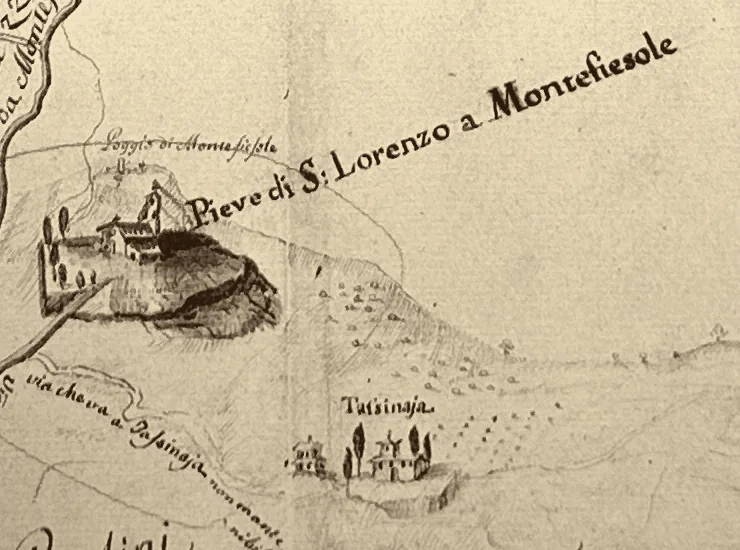
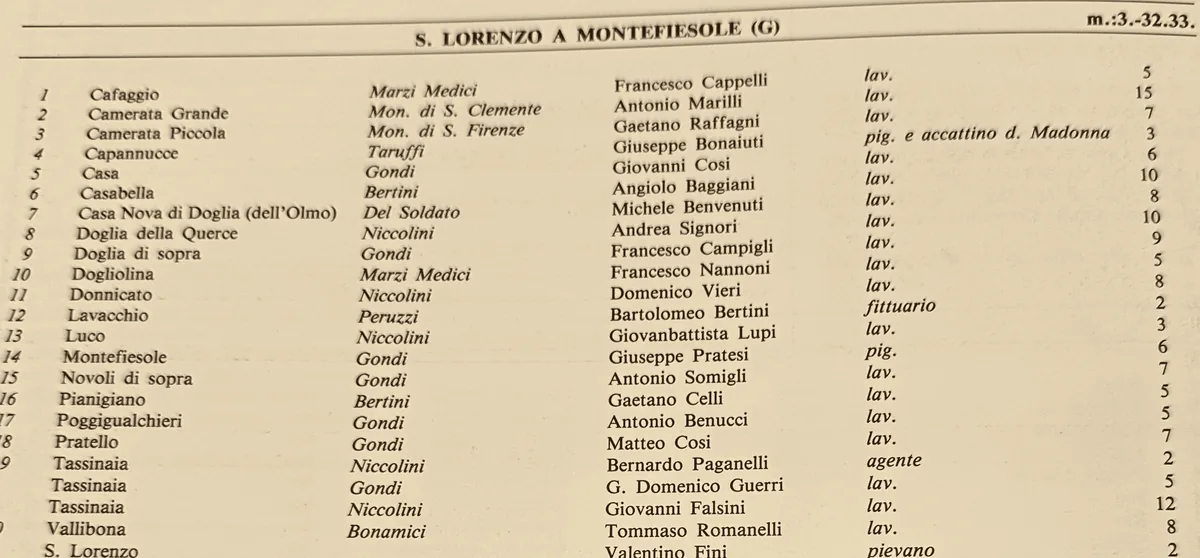
In a table of the farms of the parish of S. Lorenzo a Montefiesole, Tassinaia appears three times: two farms owned by the Niccolini and one by the Gondi. Next to the owners are the names of the people who worked them, including an “agente” (estate agent), Bernardo Paganelli.
Montefiesole, the Bishops’ hill
Above Tassinaia rises the hill of Montefiesole. On the summit, north of the church, are the modest remains of a double ring of walls: the castle that was the residence of the Florentine Bishops from the 12th century. The oldest mention of the castle dates from 1196; the district was run on the Bishop’s behalf by a Podestà whose jurisdiction reached Vico, Pievecchia, Monte Rinaldi, Valcava and Pagliariccio. In 1251 seventy-one tenant farmers of Montefiesole swore loyalty to Giovanni da Velletri, the Bishop’s envoy.
Tradition attributes Roman origins to the walls, and one hypothesis places a temple to a solar deity here. The texts themselves call it “as suggestive as it is debatable”: it is conjecture, not fact. More concrete are the Roman-era remains found in the 19th century near the nearby Villa Strozzi. According to one of the guides, the name Montefiesole may be linked to an ancient road climbing the hill from Ponte a Vico.
The Pieve di San Lorenzo and the Madonna del Parto
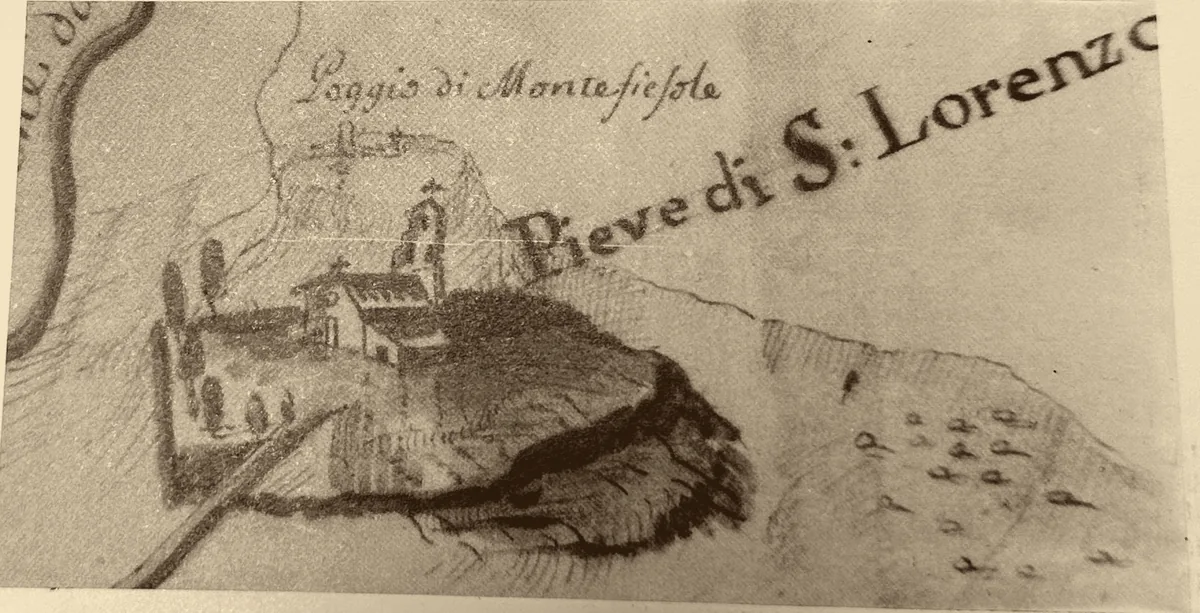
The Pieve di S. Lorenzo a Montefiesole (480 m) is tucked into a dense cypress grove just below the summit. A document of 1190 already mentions it as a collegiate church, and a deed of gift dated 10 December 1461 records it as a pieve. It largely keeps its original Romanesque plan with three naves and five bays. At its altar an image of the Virgin Mary del Parto is venerated, considered by scholars to be later than Giotto (modern records attribute it to Antonio Veneziano, late 14th century); the chapel opposite has a fresco of the Deposition from the Cross. In 2018 Cardinal Giuseppe Betori proclaimed the church the Sanctuary of the Santissima Annunziata di Montefiesole. Read more in our article on the Pieve di San Lorenzo a Montefiesole.
On 9 March 1393 Gentile, son of the famous Florentine physician maestro Tommaso del Garbo, bought, among other things, two farms with seven plots of land on the hill of Montefiesole, in the parish of the pieve of S. Lorenzo.
Stay in a hamlet with seven centuries of history
Stay at Tassinaia on the hills of Montefiesole: the same land shown on the old maps, among olive groves and woods.
- Historical guide to the Pontassieve area (early 20th century), pp. 724–727.
- A. Boglione, I. Moretti, “I castelli della podesteria del Ponte a Sieve”, in Le antiche leghe di Diacceto, Monteloro e Rignano. Un territorio dall’antichità al Medioevo, ed. I. Moretti, Pontassieve 1988, p. 208.
- Book on the castles of the area, entry “Castello di Montefiesole”.
- 19th-century historical-geographical dictionary, entry “Monte-Fiesole”, p. 389.
- Book on the historic roads of Quona and Montefiesole, p. 104 (farm table and Paganelli’s drawing).
- Historic maps “Strade dentro il Territorio de’ Popoli di S. Lorenzo a Montefiesole…” and “Strade giacenti dentro i Popoli di S. Martino e S. Giusto a Quona”.
- Pieve di San Lorenzo: EcoMuseo della Montagna Fiorentina (ecomuseomontagnafiorentina.it) and Wikipedia, “Pieve di San Lorenzo a Montefiesole”; 2018 sanctuary: montefiesole.com.
- Oral tradition of the Passigli family, interview by Gherardo Cavalieri.